
A New Winter Folklore

Film & Culture | CelticMFF Magazine — Christmas 2026
Two animated Christmas films from Wales and Ireland are doing something more interesting than preserving Celtic folklore. They’re creating new stories for another generation to inherit.
Every old story was new once.
Before a tale became folklore, before anyone described it as tradition, somebody told it for the first time.
That can be easy to forget when we talk about preserving culture.
Preservation matters. Languages disappear. Stories disappear. Customs disappear. Sometimes remarkably quickly.
But a living culture cannot survive entirely on things inherited from the dead.
Someone has to make the next thing.
At Christmas 2025, two animated films offered very different examples of what that can look like.
A new ghost for a Welsh winter
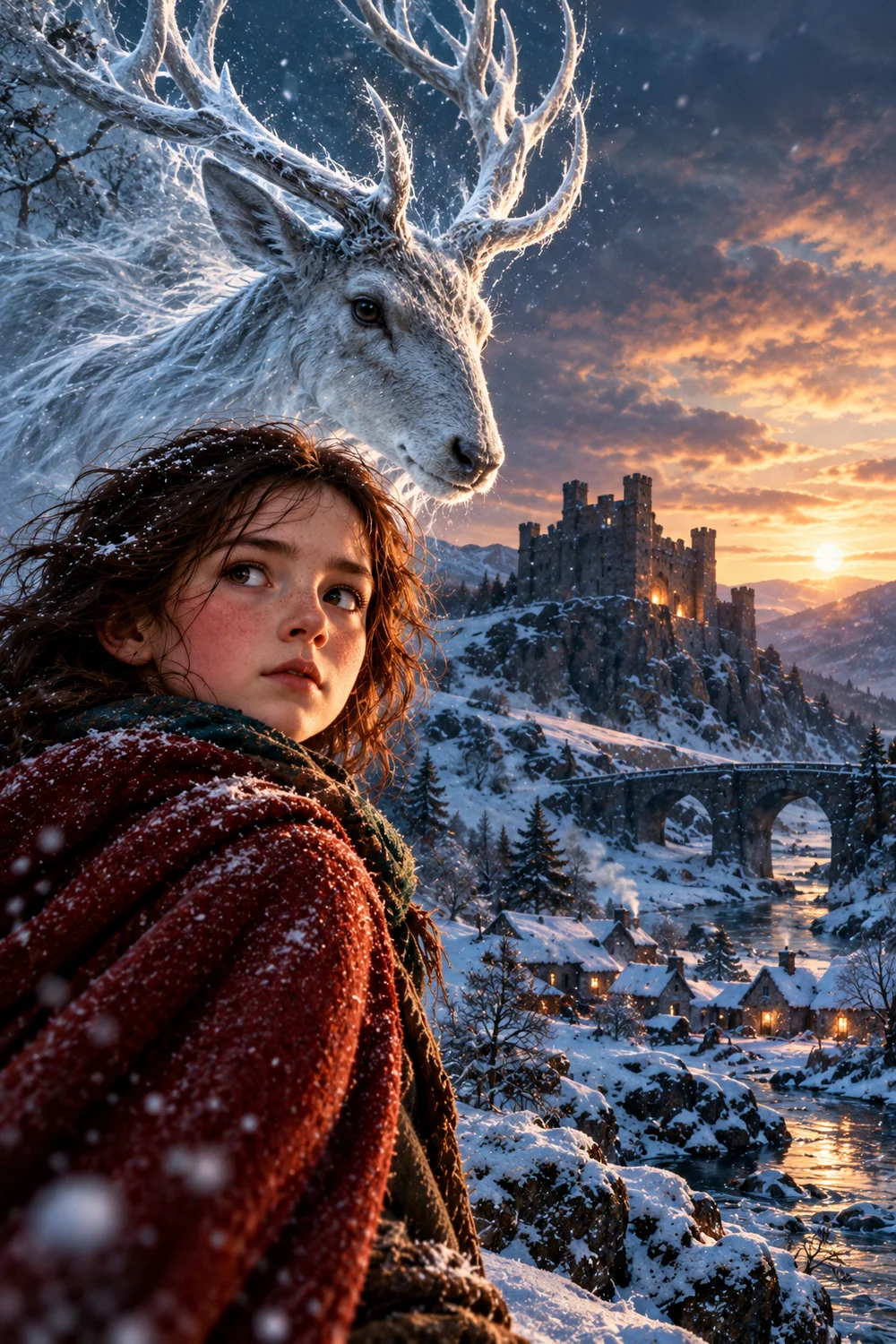
In Wales, Ysbryd yr Oerfel — The Ghost of Midwinter sent a young girl named Nia into a medieval Welsh snowstorm, where saving her father requires a dangerous bargain with a winter spirit.
It sounds like the sort of story someone might have collected from oral tradition a century ago.
It isn’t.
Director and story creator Jon Rennie set out to make a new Welsh fable.
That distinction matters.
Rather than taking an existing piece of folklore and polishing it for modern television, the filmmakers borrowed the language of old winter storytelling—dark woods, danger, family, supernatural forces and the long cold of midwinter—and made something that had not existed before.
The result belongs to a tradition without pretending to be an ancient part of it.
And that is an important distinction for a culture whose stories have so often been passed from one generation to the next through the spoken word.
A new tale can draw upon familiar landscapes, fears and beliefs without claiming a history it does not possess.
It can become part of the conversation.
Whether it becomes part of the tradition is something future generations will decide.
Watch the trailer: The Ghost of Midwinter
Official trailer for The Ghost of Midwinter / Ysbryd yr Oerfel, from Cloth Cat's YouTube channel.
A Christmas deer between two languages
Elsewhere, another deer was discovering that he wasn’t quite who he thought he was.
Nollaí, known as Nolig in Welsh, begins with a deer who has grown up as part of a human family. Then he discovers that he may be something extraordinary: the last surviving giant Irish deer.
His search for where he came from leads eventually to another world and others like him.
He is offered something powerful: a way back to his origins.
But origins and home are not always the same thing.
That question gives the story a place in the Christmas tradition, where journeys home are so often presented as journeys back to where we began.
Sometimes belonging is more complicated.
The film itself crossed another kind of boundary.
Nollaí/Nolig emerged from a collaboration between Irish- and Welsh-language broadcasters, bringing a new Christmas story to children in two living Celtic languages.
That collaboration is significant beyond the film itself.
Irish and Welsh are distinct languages, each with its own history, literature and traditions. Neither needs to become the other to share a story.
Instead, children can encounter the same characters and ideas through the sounds and expressions of their own language.
For families raising children bilingually, or working to reconnect with a language that earlier generations were discouraged from speaking, that matters.
A language needs more than textbooks and historical documents.
It needs jokes, adventures, songs, arguments, imaginary worlds and Christmas stories.
It needs children who associate it not only with lessons, but with delight.
Watch the teaser: Nollaí / Nolig
Official Nollaí teaser, from TG4's YouTube channel.
The stories we haven’t inherited yet
There is a temptation, particularly when discussing Celtic culture, to look backward.
To ancient myths. To lost kingdoms. To customs recorded before they disappeared. To stories collected by people who understood that something precious was slipping away.
That work remains essential.
But preservation alone cannot provide everything a living culture needs.
Children deserve more than the responsibility of remembering.
They deserve the freedom to imagine.
That is what makes these two films interesting companions.
One creates a winter spirit who feels as though she might have stepped out of an old Welsh tale.
The other gives a prehistoric deer a thoroughly modern question about identity and belonging.
Neither requires its audience to have studied Celtic mythology before the story begins.
Both invite children into imaginative worlds shaped by the cultures and languages around them.
And perhaps that is how new traditions begin.
Not with an announcement that something has become folklore, but with a child asking to hear the story again.
A parent remembers it.
A grandparent learns it.
Someone retells a favorite part, changes a detail or invents another adventure.
Years later, the story is still there.
We cannot know whether The Ghost of Midwinter or Nollaí/Nolig will become Christmas traditions.
That belongs to the children watching them now.
But the filmmakers have done something worth celebrating.
They have given those children new stories in which their languages, landscapes and imaginations have a place.
Every old story was new once.
And somewhere this Christmas, a child may be hearing a story that will one day feel as though it has always been there.