
Irish Christmas in America
For twenty-one Christmases, Oisín Mac Diarmada and Irish Christmas in America have carried the music, stories and traditions of Ireland across an ocean. Somewhere along the way, a holiday show became something more.
There are easier ways to spend December.
For more than two decades, while families have been hanging decorations and making their way home for Christmas, Oisín Mac Diarmada has packed a fiddle and headed in the opposite direction.
Across the Atlantic. Across America. From one theater to another.
With him have gone harps and pipes, singers and dancers, old photographs, older songs, stories and traditions—pieces of an Irish Christmas carried thousands of miles from the places that made them.
The production is called Irish Christmas in America. It is an accurate name.
After twenty-one years, though, it feels like an incomplete one.
Because what Mac Diarmada has been carrying across America since 2005 isn’t simply a Christmas concert.
He has been carrying memory.
Beyond the music
When Irish Christmas in America first went on the road in 2005, Mac Diarmada was already accustomed to touring the United States with the traditional Irish band Téada.
But this was intended to be something different.
At the time, he described the new production as an opportunity to present Ireland’s wider cultural history and traditions—not simply the music audiences might encounter at an ordinary concert.
That distinction has endured.
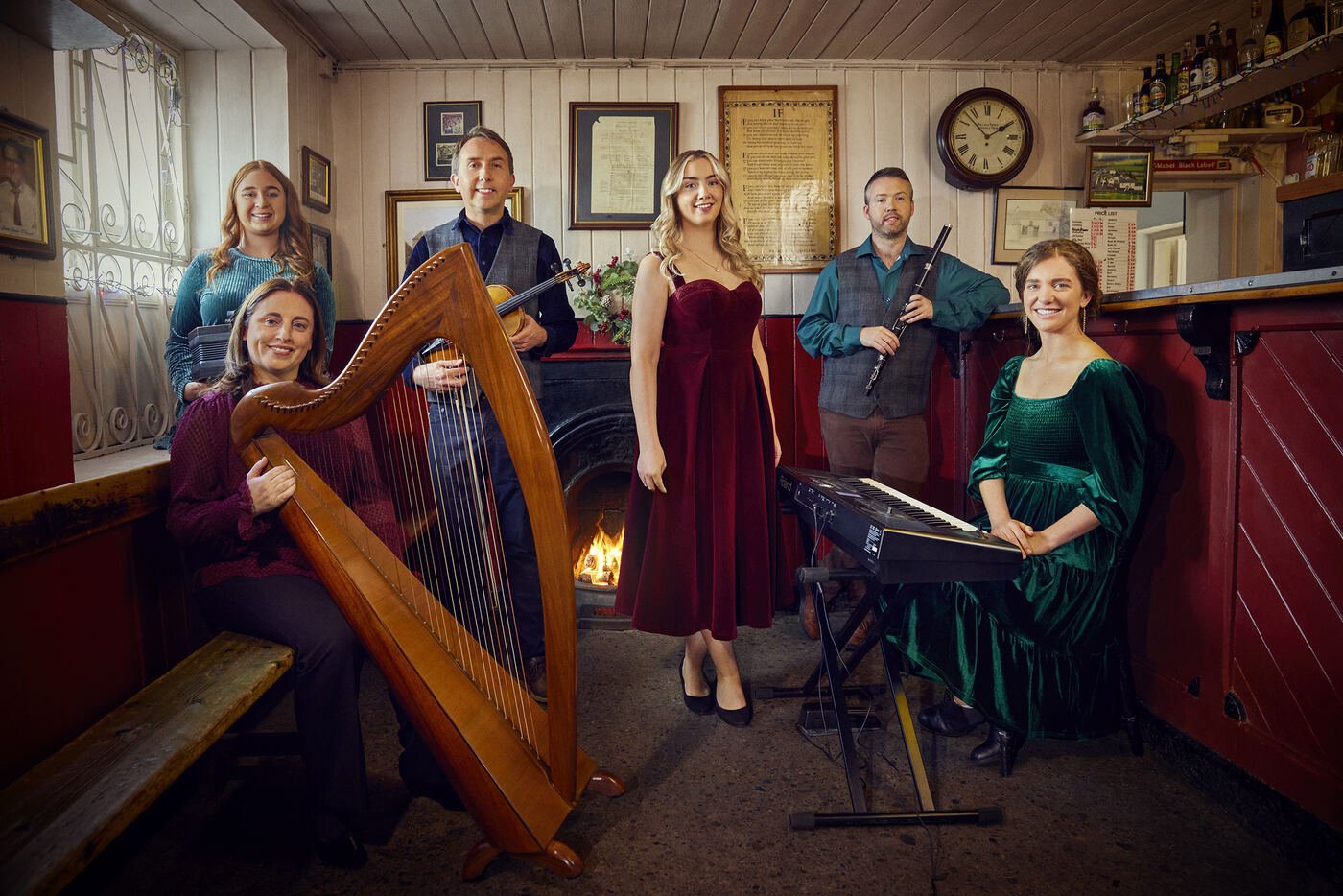
There is extraordinary music, certainly. Fiddle, harp, concertina, flute and uilleann pipes have filled the production over the years, alongside singers, dancers and storytellers. Historic and evocative images of Ireland form part of the performance as well. The 2026 production features Mac Diarmada on fiddle, vocalists Laura Jo and Jack Warnock, Gráinne Hambly on Irish harp and concertina, Caoimhín Ó Fearghaíl on uilleann pipes and flute, and Samantha Harvey on piano and dance.
But the instruments have always been carrying something with them.
Christmas is particularly good at exposing the difference between a place and a home.
For generations of Irish emigrants, December could make an ocean feel wider. Those who had left carried pieces of Ireland with them: songs, stories, food, customs, turns of phrase and music learned from people whose faces they might not see again for years—or ever.
Mac Diarmada has described emigration as one of the show’s most heartfelt themes.
“Music was a way that people stayed close to home,” he has said.
It may be the sentence that best explains Irish Christmas in America.
“Music was a way that people stayed close to home.”— Oisín Mac Diarmada
The traditions that travel
Some of what the production carries would once have been familiar in communities across Ireland and considerably less familiar to an American audience.
The Wren Boys tradition was part of the show from its beginning.
Associated with St. Stephen’s Day on December 26, the old custom traditionally sent groups from house to house in disguise, accompanied by music and performance. When Irish Christmas in America debuted in 2005, the Wren tradition was specifically among the customs Mac Diarmada wanted American audiences to encounter.
By 2018, he was still talking about it.
The practice had changed—literal hunting of the wren had long since given way to symbolic versions of the custom—but in places such as Dingle, public Wren celebrations continued to bring people into the streets. Mac Diarmada connected their survival with something larger: the need to preserve social bonds and community in a changing world.
That may be why presenting tradition as something living matters.
A tradition kept behind glass can be preserved.
A tradition sung, danced, changed, taught and shared can survive.
Irish Christmas in America has never been frozen in 2005.
The artists have changed. The repertoire has changed. Contemporary songs have appeared beside material hundreds of years old. Mac Diarmada has said that the early years were a process of experimentation: trying things, watching audiences and learning what worked. Some of the original production, he later concluded, had simply been too heavy.
That willingness to listen may be one reason the show is still traveling twenty-one years later.
An unexpected audience
Mac Diarmada once assumed something about the people who would come to see it.
Surely, a show built around Irish music and tradition would find its strongest response in American communities with deep Irish roots.
That isn’t what happened.
He has recalled discovering that the production could be every bit as successful in places without an especially strong Irish connection. Audiences in New Mexico, Texas, California and Oregon responded too. For Mac Diarmada, it was a revelation—and it influenced the way the production developed.
Perhaps it shouldn’t be surprising.
You don’t have to be Irish to understand missing somewhere.
You don’t have to have crossed an ocean to know what it means to want everyone you love around the same table.
You don’t need an Irish grandmother to recognize the strange power of a song you haven’t heard in years, or the way a tradition repeated every December can suddenly collapse time.
Christmas is full of ghosts that way—not frightening ones, necessarily, but the people and places that remain present because we remember how things were done when they were there.
And every generation eventually becomes responsible for deciding which of those things will be carried forward.
The people who carried it
Twenty-one years is long enough for a production to acquire its own history.
The list of artists who have appeared with Irish Christmas in America reads like a remarkable cross-section of Irish traditional music: Karan Casey, Cara Dillon, Muireann Nic Amhlaoibh, Cathie Ryan, Michael Londra, Cathy Jordan, Caitríona Sherlock, Niamh Farrell, Pauline Scanlon and Eilis Kennedy of Lumiere, and others.
Among them was the great West Kerry singer and accordionist Séamus Begley.
Begley brought more than musicianship to the stage. His singing came from the Irish-speaking Gaeltacht of West Kerry and a musical tradition rooted deeply in place; his storytelling and wit were as much a part of his presence as the accordion in his hands. He appeared in multiple seasons of Irish Christmas in America, sometimes alongside his daughter Méabh.
Begley died in 2023.
Today, the Irish Christmas in America site remembers him simply and affectionately as the legendary Kerry singer and accordionist who had been part of its story.
His absence gives an idea like preservation a different weight.
Tradition is sometimes discussed as though it belongs primarily to the past: old songs, old customs, old photographs, old ways of celebrating.
But traditions aren’t carried by the past.
They are carried by people.
And people do not remain forever.
Perhaps that is why the twenty-first year of Irish Christmas in America means more than another number added to a tour poster. For two decades, musicians have stepped onto these stages, carried something for a while and eventually handed it to someone else.
The names change.
The music continues.
Home for Christmas
There is a lovely contradiction at the center of all this.
To spend December presenting a show about the pull of home, Mac Diarmada has repeatedly had to leave his own.
He lives in a small village in County Sligo. In 2019, when asked about his own Christmas traditions, he talked not about anything grand but about enjoying the quiet rural life there, where his parents also lived. He acknowledged that touring meant missing much of the Christmas season at home.
A year earlier, speaking between American tour stops, he described the great modern Irish Christmas migration: emigrants pouring back through Ireland’s airports from the United States, Canada, Australia and elsewhere.
People coming home.
At the end of a run of 28 performances in four weeks, he was asked whether the musicians would do the same.
“We sure will,” he replied.
Home for Christmas.
There is something beautifully circular about it.
Every winter, a group of musicians leaves Ireland carrying pieces of home with them.
For a few weeks, those pieces appear in theaters thousands of miles away. An uilleann pipe sounds. A fiddle begins. Someone sings a song written before anyone in the room was born. Old photographs appear behind them. Feet strike the stage. Someone who grew up in Ireland remembers something. Someone whose grandparents left Ireland recognizes something they never personally knew.
And someone with no Irish ancestry at all simply understands.
Then the final performance ends.
The instruments go back into their cases.
And the people who have spent December carrying home to everyone else begin making their own way home.
Next year, they will pick it up again.
Irish Christmas in America — 2026
Irish Christmas in America celebrates its 21st year in 2026, with performances across the United States during the holiday season. The current company includes producer and fiddler Oisín Mac Diarmada, Laura Jo, Jack Warnock, Gráinne Hambly, Caoimhín Ó Fearghaíl and Samantha Harvey.