
Who Gets to Write the Next Old Story?
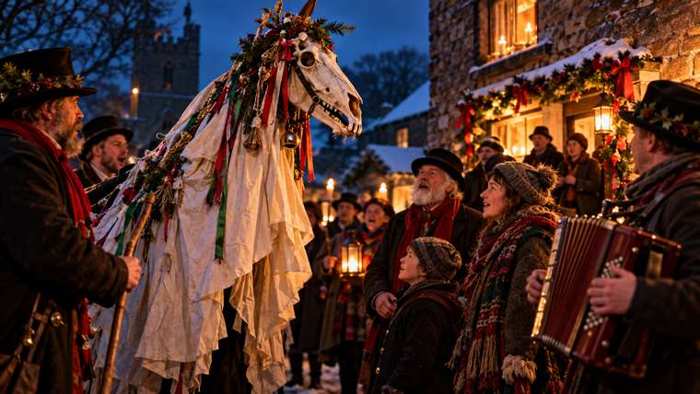
Traditions have a public-relations problem.
Once a custom survives long enough, somebody eventually describes it as “ancient,” “unchanged” or “lost to the mists of time.”
Real traditions are usually messier and more interesting.
They disappear. They return. Churches suppress them. Communities revive them. Families alter them. Children inherit pieces their grandparents thought were ordinary.
Sometimes a tradition survives because people refuse to let it disappear. Sometimes it survives by changing. Sometimes it vanishes almost completely and somebody goes looking for it again.
At Christmas and midwinter, the Celtic world is full of customs that prove the point.
Wales — A Horse at the Door
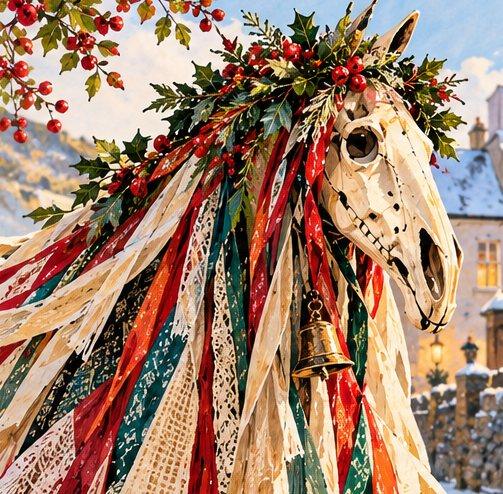
In parts of south Wales, the Mari Lwyd turns the winter doorstep into a performance.
A decorated horse figure, historically often incorporating a real horse skull beneath a white cloth, travels with a group from house to house. Songs and improvised verses are exchanged at the door before the party is admitted for food, drink and more celebration.
The earliest known written account dates to 1798. Like many folk traditions, Mari Lwyd did not travel neatly and uninterrupted from some unknowable ancient past to the present day. Its popularity changed. In some places it declined. In others it survived or was revived.
Today, the strange white horse still appears.
That makes Mari Lwyd interesting for reasons beyond its considerable ability to terrify anyone encountering it unexpectedly after dark.
Who owns a revived tradition?
The people who remember it?
The people who reconstruct it?
Or the people who take part in it now?
Wales offers another example in plygain, the tradition of Christmas carol singing historically associated with services held very early on Christmas morning. Accounts describe singers performing carols individually and in groups, sometimes after communities had spent much of the night awake together.
In some places, people waiting for plygain made cyflaith, pulled treacle toffee.
The waiting became part of Christmas too.
Ireland — A Light for Someone Coming Home
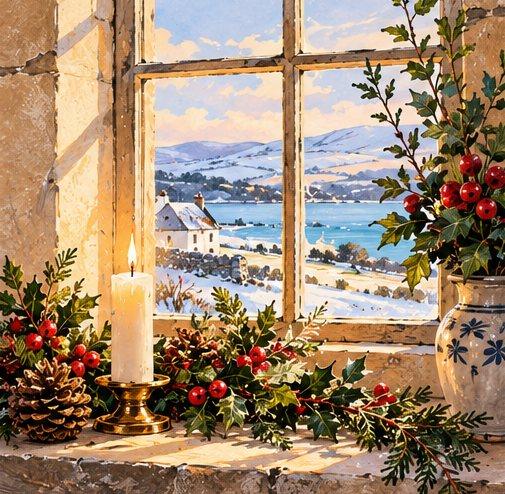
In accounts preserved by Ireland’s National Folklore Collection, Christmas Eve candles appear again and again.
The explanations vary.
Some were lit in welcome to Mary and Joseph or the Holy Family. Some accounts describe the light as a welcome for a traveller who might need food or shelter. In some homes, doors were left unlatched and fires kept bright.
The details belong to particular families and communities.
The larger idea is recognizable.
On Christmas Eve, the house announces that someone may come in.
That image carries particular weight in a country whose history sent generations of people elsewhere.
The modern phrase home for Christmas can sound almost sentimental through repetition.
A candle in a window makes the idea physical.
Someone may be out there.
Someone may be coming home.
And there will be a light when they arrive.
Scotland — The Christmas That Disappeared
Scotland complicates any easy story about an uninterrupted “ancient Celtic Christmas.”
After the Scottish Reformation, the Church of Scotland rejected Catholic holy days and festivals. In 1575, its General Assembly abolished the observance of holy days including Yule. Parliament later abolished the Yule vacation observed by the courts in 1640 and again in 1690. Although parts of those acts were later repealed, the Church continued to discourage Yule celebrations.
Christmas did not vanish completely. People continued to observe it privately, and practices varied.
But culturally, the interruption was profound.
Christmas remained subdued in Scotland for generations while Hogmanay carried much of the weight of the winter celebration. Christmas Day did not become a Scottish public holiday until 1971.
That interruption matters.
Traditions do not only survive.
Sometimes the chain breaks.
Sometimes institutions break it.
Sometimes social and religious values change and people themselves stop practicing something.
And sometimes, generations later, people begin again.
Modern Scottish Christmas consequently contains layers: older practices, customs shared with the wider British and international Christmas, revived traditions and newer ones.
Even absence can leave an inheritance.
Cornwall — When the Retelling Becomes the Tradition
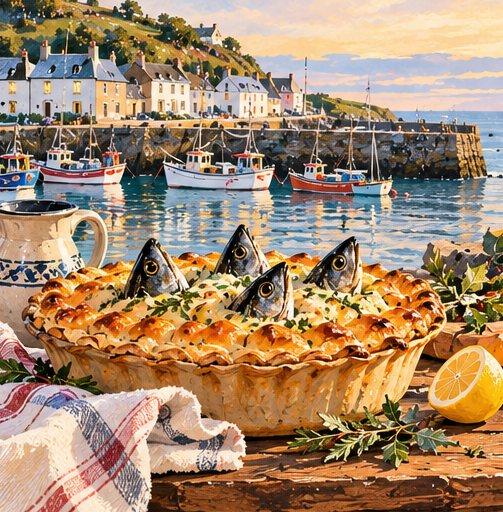
In Mousehole, Christmas has a fish pie with heads looking out through the crust.
On December 23, the village marks Tom Bawcock’s Eve, a tradition built around the story of a fisherman who went to sea when others could not and returned with enough fish to feed the community.
Except even the story itself refuses to sit still.
When Cornish scholar Robert Morton Nance collected accounts from Mousehole fishermen in the early twentieth century, he found different versions. In some, Tom Bawcock braved dangerous weather and saved the village from hunger. In others, the details were different.
Nance turned the material into verse. Ralph Dunstan set it to music in The Cornish Song Book in 1929. The song became associated with serving stargazy pie in Mousehole on December 23 and was later carried to wider audiences by Cornish singer Brenda Wootton.
There is something wonderfully inconvenient about that history.
Which part is the tradition?
The fisherman?
The stories fishermen told about him?
The song written from those stories?
The pie?
The annual gathering that grew around all of it?
Perhaps the answer is all of them.
Tradition does not always preserve a single historical moment.
Sometimes it accumulates.
A village tells a story.
Someone writes it down.
Someone turns it into a song.
People sing the song while eating the pie.
Children grow up knowing that December 23 means Tom Bawcock’s Eve.
Eventually, the retelling becomes part of the thing being retold.
Cornwall offers an even more explicit example nearby in Penzance.
The modern Montol midwinter festival began in 2007, drawing deliberately on documented West Cornish guise-dancing traditions. Contemporary celebrations combine surviving material, revival and reconstruction.
That does not make the tradition false.
It tells us something about how traditions are made.
Isle of Man — Catching the Wren Again
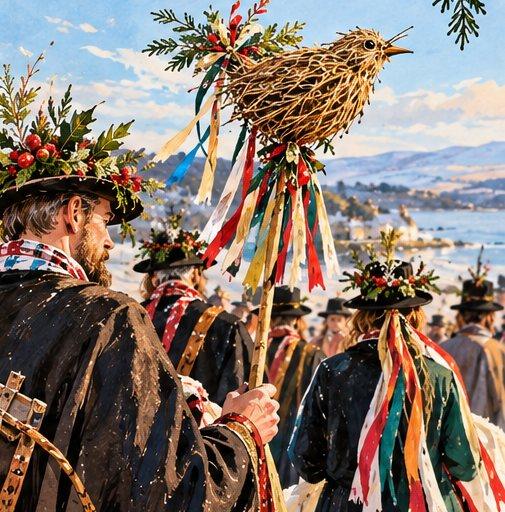
On December 26, people still take to the streets of the Isle of Man to Hunt the Wren.
No actual wren need fear for its life.
Today’s bird is a replica, carried on a decorated pole while communities gather to sing and dance. Hunt the Wren remains a living St Stephen’s Day tradition, with gatherings held in communities around the island.
The older custom was less friendly to the bird.
But that change is precisely what makes Hunt the Wren useful here.
If maintaining a tradition required preserving every detail exactly, the choices would be uncomfortable: kill the wren or abandon the custom.
Instead, the bird changed.
The gathering remained.
People kept the music, the dancing, the decorated pole and the communal ritual while leaving an actual wren out of it.
The result raises a question that appears again and again whenever people talk about authenticity.
How much can a tradition change and still be the same tradition?
Perhaps the wrong thing is being measured.
A tradition is not necessarily the object in the center of the ritual.
It may be the act of people agreeing to gather again next year.
The replica wren is different.
The decision to meet on December 26 and carry it through the streets is familiar.
Sometimes continuity lives in the repetition rather than the details.
Brittany — The Songs Remember
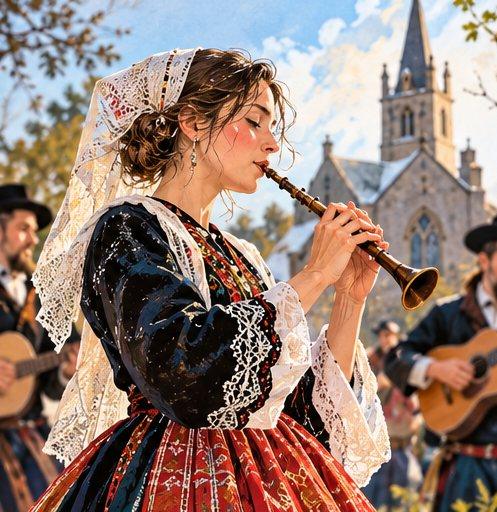
Brittany offers a different kind of survival.
Not a horse at the door or a bird on a pole.
A song.
Breton Christmas music survives in a substantial documented repertoire. Songs that once passed through communities by memory and voice have also been collected, written down and preserved.
But preservation is only half the story.
In 2020, Ar Gedour published Kantikoù Nedeleg, a collection of thirty Christmas songs from Upper and Lower Brittany. It includes lyrics, translations and musical scores, along with arrangements for bombarde.
The interesting part is what the collection was made to do.
It was not intended simply to preserve old songs in a book.
It was designed so people could sing them again.
Singers, musicians and choirs could learn the music. Parents could pass it to their children. Recordings and digital tools could help a new generation learn songs that previous generations had carried by memory and voice.
That is preservation becoming something else.
Someone remembers a song.
Someone writes it down.
Someone collects it.
Someone publishes it.
Someone encounters it decades later.
And breath enters it again.
The singer may not have learned the carol from a grandmother beside a fire.
Does that make it less inherited?
Or has the chain simply acquired another link?
An archive can preserve a song.
Only people can make it music again.
Galicia — The Seventh at the Table
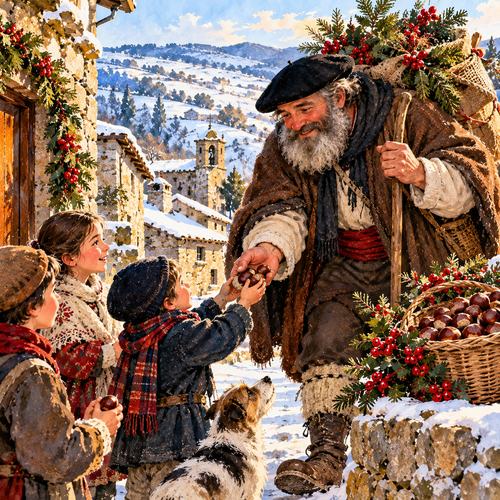
The traditional list of Celtic nations contains six, united in part by their Celtic languages. But the modern Celtic world has never fit quite so neatly into six boxes.
Galicia, in northwestern Spain, has no surviving Celtic language; Galician is a Romance language. Yet its music, festivals and strong modern identification with Celtic heritage have given it a place in the wider Celtic cultural world. Some organizations and festivals consequently speak not of six Celtic nations, but seven.
Galicia’s place on that list is debated. Its place in the contemporary Celtic conversation is much harder to ignore.
The Next Old Story
There is a temptation to treat tradition as a test.
Did our ancestors do this?
Did they do it exactly this way?
How old does something have to be before we are allowed to call it traditional?
But every tradition was new once.
Someone lit the first candle.
Someone sang a song nobody had heard before.
Someone changed an ingredient because the old one was unavailable.
Someone revived a custom after a generation had stopped doing it.
Someone carried a tradition across an ocean and discovered that it meant something different there.
That does not make it false.
It makes it alive.
Because tradition is not something people inherit intact.
Every generation gets a vote.
They decide what to keep.
What to change.
What to recover.
What to leave behind.
And occasionally, without realizing it, they do something together for the first time that somebody else will grow up believing has simply always been done.
Traditions survive because people keep choosing them.
Maybe the question for Christmas is not only which old traditions we can preserve.
Maybe it is which things we do together now will be the stories somebody calls old a hundred years from now.