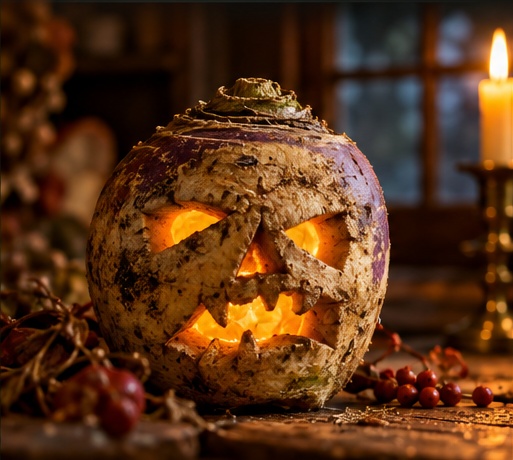
There is something wonderfully unpleasant about a carved turnip.
Unlike the cheerful orange pumpkin, with its generous proportions and friendly triangular grin, a turnip offers little encouragement to the person attempting to turn it into a lantern.
It is hard, awkward, and generally uncooperative.
Its pale flesh lends itself to deeply unsettling expressions. A crooked mouth, hollow eyes, and a candle flickering somewhere inside can transform an ordinary root vegetable into a face that looks as though it has been waiting a very long time to tell you something dreadful.
And for generations, that was precisely the sort of thing people wanted on Halloween.
Before pumpkins became the international symbol of the holiday, turnips were carved into frightening lanterns in Ireland.
Some were placed in windows. Others were carried through the darkness to startle unsuspecting neighbours.
Halloween, after all, was not originally an occasion that required its decorations to be cute.
One of the most remarkable reminders of the old custom belongs to the National Museum of Ireland.
Known as the Ghost Turnip, the object is associated with Fintown in County Donegal.
In 1943, a schoolteacher named Rois Ní Braonáin gave the museum a turnip lantern of the kind she said had traditionally been made in the area around 1900.
The museum's artist, Eileen Barnes, subsequently created a painted plaster-cast model.
The surviving representation is extraordinary.
Its carved face is grotesque rather than playful, with features that suggest something closer to a nightmare than a festive decoration.
It is easy to imagine how effective such a lantern might have been on an unlit country road.
Before electric lighting transformed rural life, darkness was a very different experience.
A small candle could provide reassurance, but placed inside a monstrous face, it could just as easily produce a fright.
The turnip lantern belonged perfectly to a night already associated with disguises, supernatural visitors, and practical jokes.
The jack-o'-lantern also has a story attached to it.
In Irish folklore, a character commonly known as Jack tricks the Devil but ultimately discovers that his cleverness has left him with nowhere to go.
Neither Heaven nor Hell will admit him.
Condemned to wander, he carries a light inside a hollowed-out vegetable to guide his way.
Versions of the story differ, as traditional tales tend to do. The familiar character of Stingy Jack belongs to a wider body of folklore surrounding mysterious lights, wandering souls, and the consequences of making bargains one cannot escape.
It would be too convenient to claim that a single tale explains every carved lantern tradition.
But the story certainly provides an entertaining companion to the custom.
Jack has outwitted the Devil, lost his place in the afterlife, and acquired an eternity of wandering.
His consolation prize is a vegetable with a light in it.
Folklore has rarely been particularly generous to its cleverest characters.
On the Isle of Man, October 31 has a name and character of its own.
Hop-tu-Naa is one of the island's distinctive seasonal celebrations, bringing together songs, dances, lanterns, stories, and traditions passed through generations of Manx families.
Here, carved turnips are known as moots.
Like their Irish counterparts, they are hollowed out and illuminated, but on the Isle of Man they belong to a particularly rich musical tradition.
Children visit homes carrying their lanterns and singing Hop-tu-Naa songs.
The words and melodies vary across the island. Communities around Peel, Ramsey, Castletown, and elsewhere have preserved their own versions.
Some songs are in English. Others preserve the Manx Gaelic language.
The differences matter.
They reveal a tradition that was never simply a uniform annual performance, but something shaped by individual communities, families, and local memories.
And unlike a custom preserved only in an archive, Hop-tu-Naa remains a living part of Manx cultural life.
Culture Vannin, the organisation dedicated to promoting Manx culture, has played an important role in documenting and sharing Hop-tu-Naa.
Its resources include recordings of traditional songs, dance instructions, historical information, and educational material for children.
Among the recordings are performances by Manx schoolchildren.
That detail is worth considering.
A museum can preserve a lantern. A photograph can show how people once dressed. A written account can explain what happened on a particular October evening.
But a song survives most fully when somebody sings it.
Each new generation must learn the words, remember the melody, and decide to carry it forward.
The continued presence of Hop-tu-Naa in Manx schools and communities is therefore more than an exercise in nostalgia.
It is cultural continuity in action.
The island's traditions have changed over time, as all living traditions do. Modern costumes and Halloween influences have joined older customs.
Yet the lanterns and songs remain recognisably Manx.
They belong to the island's own story.
The pumpkin eventually became the dominant Halloween lantern, particularly through the development of the holiday in North America.
It is not difficult to understand why.
Pumpkins are larger, easier to hollow out, and provide considerably more space for ambitious designs.
The turnip, meanwhile, requires patience, determination, and perhaps a willingness to sacrifice a perfectly serviceable kitchen utensil.
But there is something appealing about its stubborn survival.
The carved turnip reminds us that traditions do not always begin with elaborate ceremonies or magnificent objects.
Sometimes they begin with whatever happens to be growing in the ground.
A vegetable becomes a lantern.
A lantern becomes a story.
A story travels across an ocean and changes its appearance.
And somewhere on the Isle of Man, children continue to carry their own little lights through the October darkness, singing songs that connect them with generations who walked the same streets before them.
The pumpkin may have conquered Halloween.
But the turnip has not entirely surrendered.