There are plenty of reasons not to be the last person to leave a party.
You might be asked to help clean up. You might discover that everyone else has already gone home. You might find yourself trapped in conversation with somebody determined to tell one final story.
In the old Halloween folklore of Wales, however, there was a considerably more pressing reason to leave promptly.
The Hwch Ddu Gwta.
The Tailless Black Sow.
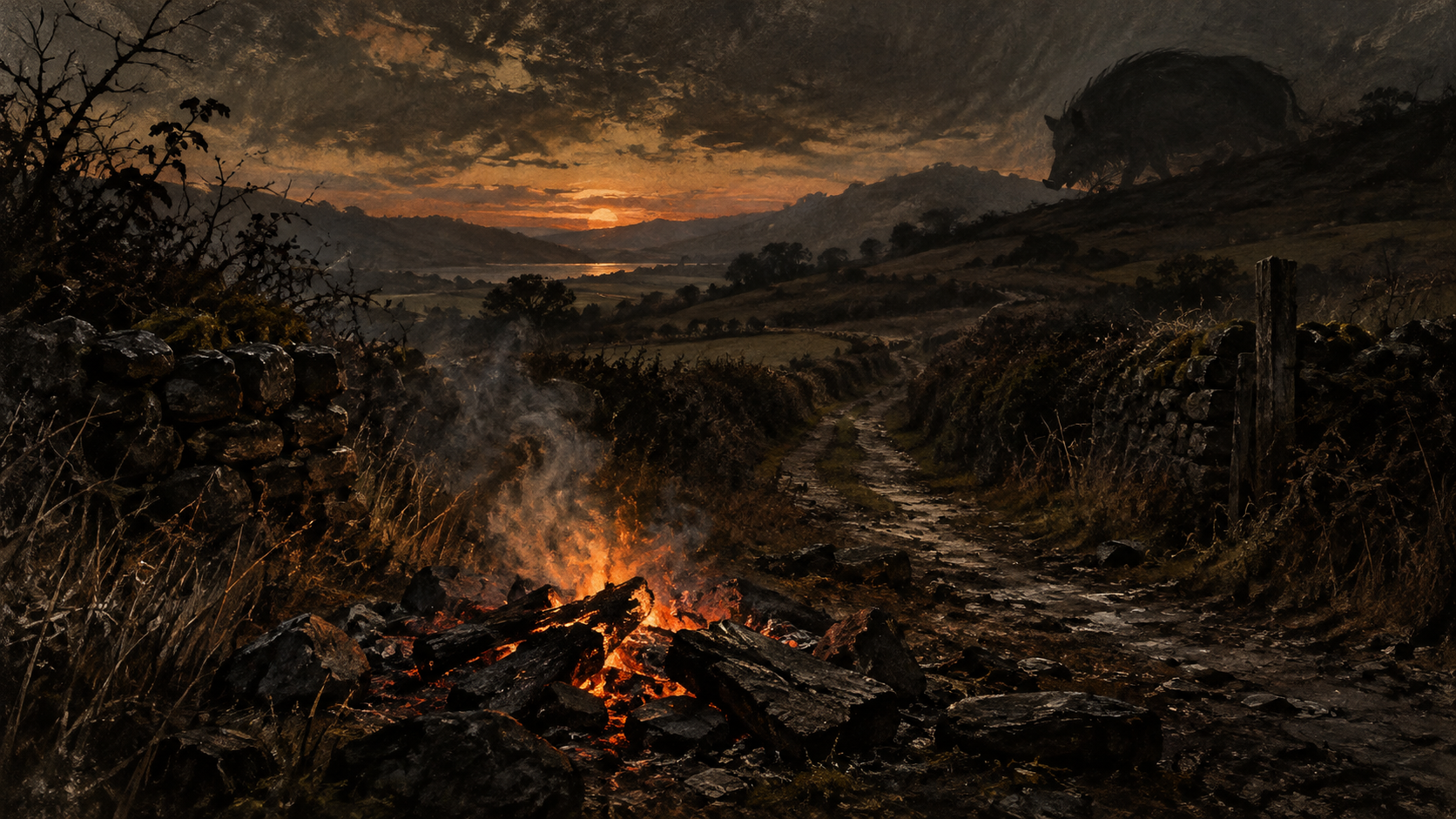
According to tradition, this fearsome creature roamed the countryside on the night of Calan Gaeaf, and anyone foolish enough to linger after the bonfire had burned low risked becoming her next victim.
She was not an ordinary pig.
She was enormous, black, terrifying, and missing her tail.
And she was sometimes accompanied by a headless woman dressed in white.
Welsh Halloween folklore has never lacked imagination.
In Wales, November 1 is known as Calan Gaeaf, the beginning of winter.
The preceding evening, Nos Galan Gaeaf, was associated with bonfires, seasonal celebrations, fortune-telling, and supernatural encounters.
Like Samhain in Ireland, it marked an important change in the traditional agricultural year.
The harvest was over. Winter lay ahead. Communities gathered to celebrate the season's turning.
But the darkness carried its own stories.
In some Welsh traditions, spirits were believed to roam freely on Halloween night. Ghosts might appear at stiles, crossroads, or other places where travellers passed between one part of the landscape and another.
Among the most memorable of these supernatural figures was the Hwch Ddu Gwta.
Her reputation was especially strong in North Wales, although the stories and warnings associated with her were recorded in different parts of the country.
She was a creature whose arrival was best avoided.
And the safest way to avoid her was simple.
Go home.
Bonfires were an important feature of traditional Welsh Halloween celebrations.
People gathered around the flames, enjoying the warmth and company as the autumn night deepened.
But eventually the fire would begin to die.
The flames sank. The embers dimmed. The surrounding darkness returned.
And with it came the warning.
A traditional Welsh rhyme declared:
Adref, adref am y cynta', Hwch Ddu Gwta a gipio'r ola'.
The meaning was unmistakable.
Get home first, because the tailless black sow would seize whoever came last.
One can appreciate the effectiveness of this particular piece of folklore.
Imagine being a child standing beside a dying bonfire.
The adults have begun leaving. The path home is dark. The trees beyond the firelight are barely visible.
Someone repeats the warning.
Then somebody else starts running.
There is very little incentive to remain behind and test the story.
Whether anyone genuinely expected to encounter an enormous supernatural pig was hardly the point.
The warning worked.
As though the black sow were not sufficiently alarming, some versions of the tradition gave her a companion.
Y Ladi Wen, the White Lady.
Welsh folklore contains several figures known by this name, and their stories vary considerably.
In accounts associated with Calan Gaeaf, she could appear as a headless woman accompanying the Hwch Ddu Gwta through the countryside.
The combination was formidable.
A gigantic black sow without a tail.
A woman in white without a head.
And an unfortunate traveller who had stayed out too late.
The stories were not necessarily intended as elaborate supernatural explanations of the world.
They were also entertainment, warnings, and part of the shared imaginative landscape of rural communities.
Their details changed with the teller.
That is one of folklore's great strengths.
A story does not have to remain fixed to remain recognisable.
The Hwch Ddu Gwta belongs to a wider tradition of supernatural creatures associated with seasonal boundaries.
Halloween was a particularly suitable occasion for such tales.
The agricultural year was changing. Daylight was retreating. The familiar countryside could seem strange after dark.
Before modern street lighting, travelling at night meant negotiating paths, fields, and roads with little more than moonlight or a small lantern.
A strange sound in the hedgerow might have an entirely ordinary explanation.
But ordinary explanations are not always the first ones that come to mind when somebody has just told you that a monstrous pig is wandering the neighbourhood.
It is tempting to interpret every frightening figure as the remnant of an ancient religious belief.
The evidence rarely allows such certainty.
The black sow may have carried different meanings for different communities and generations.
She could serve as a warning, an embodiment of seasonal danger, a memorable character in a frightening story, or simply an excellent way to persuade children that it was time for bed.
None of these possibilities makes the tradition less interesting.
If anything, they make it more recognisably human.
Today, the Hwch Ddu Gwta survives in accounts of Welsh folklore, museum collections, and retellings of the old Halloween traditions.
The image remains wonderfully unsettling.
A dying bonfire.
An empty country road.
A warning shouted into the darkness.
And somewhere beyond the last flicker of firelight, the possibility of something large and black moving through the fields.
Perhaps the most remarkable thing about the story is its simplicity.
It requires no elaborate mythology, no complicated explanation, and no great supernatural battle.
Just a creature nobody wants to meet and a warning everybody understands.
Be the first one home.
Because if you're the last, something might be waiting.
And on Nos Galan Gaeaf, it would be a shame to discover that the old stories were right.